







Flag of Sri LankaSri Lankan school syllabus · Grades 6–10
AI-powered personalised learning

Finds the gaps. Fixes them. 10 minutes a day.

The full Sri Lankan school syllabus.

Loris learns what your child knows and what they keep forgetting, across Maths, Science, English, History and every other subject. Then it builds a short daily plan, chapter by chapter, on the national syllabus.

  • Free during launch, no card
  • NIE textbooks, chapter by chapter
  • No ads, no chat
  • Made in Sri Lanka

Grades6–10Full syllabus

Why Loris

Four reasons it works.

  • Built on learning research

    Every feature uses a study method that decades of research show works: recalling, spacing, feedback.

  • Knows your child

    Loris tracks every fact your child answers and picks each day's questions for their weak spots. No two children get the same review.

  • Instant feedback

    Every practice answer is marked straight away, with the explanation and the exact note, so mistakes are fixed while they are fresh.

  • Learning is fun

    Streaks, XP, stars, outfits and friendly weekly leaderboards. Students come back because they want to.

See the research behind each feature →

Every subject your child studies, Grades 6 to 10

  • Mathematics
  • Science
  • English
  • Sinhala
  • Tamil
  • History
  • Geography
  • Civics
  • ICT
  • Health
  • General Knowledge
  • Buddhism
  • Hinduism
  • Islam
  • Christianity
  • Art
  • Music
  • Dance
  • Drama
  • Practical Skills
Try one

This is what 10 minutes feels like.

Answer a Grade 7 Science question from Loris. Every answer tells Loris a little more about what your child knows, and when to ask again.

Grade 7 · ScienceQuestion 1 of 10

Which gas do green plants take in from the air to make their food?

How it works

A study plan that knows your child.

Loris tracks every fact your child learns, from New to Mastered, and spends their time on the ones that are slipping.

Today's Review

It remembers what your child forgets.

Each day Loris, our slender loris, picks about 10 questions: facts that are due a refresh, ones your child missed, and a few new ones. It says why each one is there, and when it will come back.

  • Every fact climbs a five-step ladder to Mastered
  • Weak topics shows the headings that need work, each with a "Fix it" button
  • "See the note" opens the exact line of the chapter notes
⭐ Loris recommends
  • Do it every day, straight after the Quiz of the Day
  • Keep going on weekends and holidays. A little every day beats a lot once a week.
  • Don’t skip the facts they missed. That’s where the learning happens.

🔬 Why it works Spaced repetition: facts reviewed at growing intervals, timed to your child, are forgotten far less. (Ebbinghaus, 1885; Cepeda et al., 2006)

Parents: real progressStudents: no wasted time

Exam game plan

A test coming up? We'll make a plan together.

Your child sets the test date, the chapters and how many minutes a day they can give. Loris lays out the days, Learn, Strengthen, Mock, Test day, and checks the plan is realistic before they start.

  • Today's mission as a simple question target
  • "On plan", "Ahead" or "A bit behind", never a guilt trip
  • A full mock test before the real one
⭐ Loris recommends
  • Set the plan as soon as the test date is announced, ideally 3–4 weeks ahead
  • Choose daily minutes your child can keep up. Even 15 is enough.
  • Take the mock test a few days before the exam, not the night before

🔬 Why it works Distributed practice: study spread over days beats the same time crammed into one night, and a concrete plan helps students follow through. (Cepeda et al., 2006; Gollwitzer, 1999)

Term testsUnit tests
Quiz of the Day

The 5-minute habit that keeps a streak alive.

Up to 10 timed questions from your child’s grade, once a day. Accuracy wins; speed adds a small bonus. Students come back for the streak and the XP, and the learning comes with them.

  • Streak rewards at 3, 7, 14 and 30 days
  • XP, levels and avatar outfits to unlock
  • A 1-minute bonus round on the facts they missed
⭐ Loris recommends
  • Do it at the same time every day, for example right after school
  • Finish it before 6 pm so the streak is never at risk
  • Let your child answer alone. One honest try shows what they really know.

🔬 Why it works The testing effect: recalling an answer strengthens memory more than re-reading it, and a small daily routine becomes a habit. (Roediger & Karpicke, 2006; Lally et al., 2010)

Free forever
Journey

The whole textbook, one stop at a time.

Journey walks through each subject in the same order as the school textbook, a few facts at each stop, so every chapter gets covered and nothing is skipped.

  • Stars for each stop, chests for each chapter
  • "9 of 24 facts mastered" on every chapter
  • Extra practice from the full question bank
⭐ Loris recommends
  • Do a chapter’s stops in the same day or week it’s covered at school
  • Replay any stop with fewer than 3 stars about a week later
  • Finish the chapter’s “Extra practice” before the term test

🔬 Why it works Mastery learning: securing each step before moving to the next. (Bloom, 1968; Kulik et al., 1990)

Short notes

Short notes for every chapter, already written.

No more evenings copying and summarising the textbook. Your child opens the notebook and the short notes are already there, clear, chapter by chapter, following the NIE textbook. Wrong answer? "See the note" opens the exact line.

  • Ready the moment they open a chapter, nothing to write up
  • Coloured tabs jump to any chapter; highlight what matters
  • "Tricky facts" gathers the ones your child keeps missing
⭐ Loris recommends
  • Read a chapter’s notes on the evening it’s taught at school
  • Then tap “Test me” on each section for a quick quiz on just that part
  • Read them again 2–3 days before a term test
  • Whenever “See the note” appears in a quiz, read the whole point, not just the answer

🔬 Why it works Immediate feedback: seeing the right explanation straight after a mistake is among the strongest influences on learning. (Hattie & Timperley, 2007)

Past papers

Real exam papers, marked instantly.

Practise a paper with hints and explanations, or sit it like the real exam under time. Loris marks it straight away and points to the weakest chapter.

  • Term test and model papers by subject and grade
  • Practice or exam mode
  • A quick test on the weakest chapter afterwards
⭐ Loris recommends
  • Do the chapter model paper once the chapter is finished at school
  • Start term papers 2–3 weeks before the test: Practice mode first, then Exam mode
  • After each paper, do the quick test on the weakest chapter

🔬 Why it works Practice testing: rated “high utility” among popular study methods, and practising in the real test’s format helps on the day. (Dunlosky et al., 2013; Morris et al., 1977)

Free forever
Friends & leaderboards

Learning is more fun with friends.

Your child adds classmates and friends, then sees a friends board and a school board built from their Quiz of the Day scores. A new season starts every Monday, so everyone gets a fresh start.

  • A friendly race with classmates, every week
  • Weekly seasons and an all-time board
  • Add friends by swapping a private code
⭐ Loris recommends
  • Add the friends they study with at school
  • Celebrate effort and streaks together, not just who’s #1
  • Use the weekly reset as a fresh goal: beat your own score from last week

🔬 Why it works Learning with peers: learning alongside others improves motivation, and points and leaderboards increase engagement. (Johnson & Johnson, 2009; Sailer & Homner, 2020)

Loris Weekly

The week's news, in a newspaper made for kids.

Every Saturday morning Loris brings out a little newspaper: 8 short stories from Sri Lanka and the world, written for Grades 6 to 10. It builds your child's knowledge of current affairs, a few minutes at a time.

  • Every story chosen and checked by a person
  • A quick puzzle at the end, never ranked
  • Free to read, no account needed
⭐ Loris recommends
  • Read it on the weekend, ideally together with a parent
  • Talk about one story at dinner. Explaining it fixes it in memory.
  • Finish it before next Saturday to keep the “weeks informed” streak

🔬 Why it works Retrieval practice: answering questions after reading helps students remember far more than reading alone. (Roediger & Karpicke, 2006)

Free forever
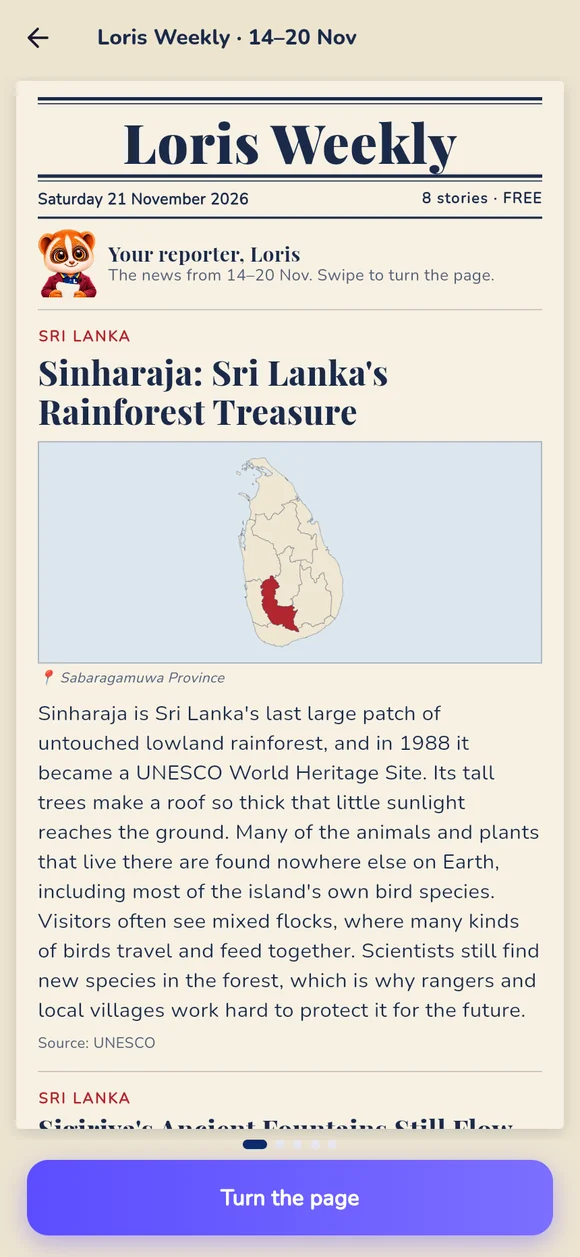
The Loris Weekly front page: the masthead, Loris the reporter, and the lead story about the Sinharaja rainforest with a map of Sri Lanka
The science

The science behind Loris.

Loris is built on decades of learning research. We didn't invent these methods: learning scientists have tested them for over a century. We built each feature around one, so your child's 10 minutes go to what works.

  • The testing effect

    Recalling an answer from memory strengthens it far more than reading it again.

    In Loris: Quiz of the Day, Today’s Review, papers, Loris Weekly

    Roediger & Karpicke, 2006
  • Spaced repetition

    Reviewing a fact at growing intervals, just before it would be forgotten, flattens the forgetting curve.

    In Loris: Today’s Review

    Ebbinghaus, 1885; Cepeda et al., 2006
  • Immediate feedback

    Seeing the right explanation straight after a mistake is one of the strongest influences on learning.

    In Loris: Every practice answer, “See the note”

    Hattie & Timperley, 2007; Butler & Roediger, 2008
  • Mastery learning

    Securing each step before moving to the next helps students learn more and remember it longer.

    In Loris: Journey

    Bloom, 1968; Kulik, Kulik & Bangert-Drowns, 1990
  • Distributed practice

    Study spread over days beats the same time crammed into one night.

    In Loris: Exam game plan, Today’s Review

    Cepeda et al., 2006; Dunlosky et al., 2013
  • Practice testing in the exam’s format

    Rated “high utility” among popular study methods; practising in the real test’s format helps on the day.

    In Loris: Past and model papers, the mock test

    Dunlosky et al., 2013; Morris, Bransford & Franks, 1977
  • Plans and habits

    A concrete plan helps people follow through, and a small daily routine becomes automatic over time.

    In Loris: Exam game plan, Quiz of the Day

    Gollwitzer, 1999; Lally et al., 2010
  • Progress monitoring

    Regularly checking progress toward a goal makes reaching it more likely.

    In Loris: Progress, Weak topics, the weekly recap

    Harkin et al., 2016
  • Learning with peers

    Learning alongside others improves achievement and motivation, and points and leaderboards increase engagement.

    In Loris: Friends and leaderboards

    Johnson & Johnson, 2009; Sailer & Homner, 2020
All sources (14)
  1. Bloom, B. S. (1968). Learning for mastery. Evaluation Comment, 1(2).
  2. Butler, A. C., & Roediger, H. L. (2008). Feedback enhances the positive effects and reduces the negative effects of multiple-choice testing. Memory & Cognition, 36(3), 604–616.
  3. Cepeda, N. J., Pashler, H., Vul, E., Wixted, J. T., & Rohrer, D. (2006). Distributed practice in verbal recall tasks: A review and quantitative synthesis. Psychological Bulletin, 132(3), 354–380.
  4. Dunlosky, J., Rawson, K. A., Marsh, E. J., Nathan, M. J., & Willingham, D. T. (2013). Improving students’ learning with effective learning techniques. Psychological Science in the Public Interest, 14(1), 4–58.
  5. Ebbinghaus, H. (1885). Über das Gedächtnis [Memory: A contribution to experimental psychology]. Leipzig: Duncker & Humblot.
  6. Gollwitzer, P. M. (1999). Implementation intentions: Strong effects of simple plans. American Psychologist, 54(7), 493–503.
  7. Harkin, B., Webb, T. L., Chang, B. P. I., Prestwich, A., Conner, M., Kellar, I., Benn, Y., & Sheeran, P. (2016). Does monitoring goal progress promote goal attainment? A meta-analysis of the experimental evidence. Psychological Bulletin, 142(2), 198–229.
  8. Hattie, J., & Timperley, H. (2007). The power of feedback. Review of Educational Research, 77(1), 81–112.
  9. Johnson, D. W., & Johnson, R. T. (2009). An educational psychology success story: Social interdependence theory and cooperative learning. Educational Researcher, 38(5), 365–379.
  10. Kulik, C.-L. C., Kulik, J. A., & Bangert-Drowns, R. L. (1990). Effectiveness of mastery learning programs: A meta-analysis. Review of Educational Research, 60(2), 265–299.
  11. Lally, P., van Jaarsveld, C. H. M., Potts, H. W. W., & Wardle, J. (2010). How are habits formed: Modelling habit formation in the real world. European Journal of Social Psychology, 40(6), 998–1009.
  12. Morris, C. D., Bransford, J. D., & Franks, J. J. (1977). Levels of processing versus transfer appropriate processing. Journal of Verbal Learning and Verbal Behavior, 16(5), 519–533.
  13. Roediger, H. L., & Karpicke, J. D. (2006). Test-enhanced learning: Taking memory tests improves long-term retention. Psychological Science, 17(3), 249–255.
  14. Sailer, M., & Homner, L. (2020). The gamification of learning: A meta-analysis. Educational Psychology Review, 32(1), 77–112.

These studies tested the methods, not Loris itself.

Loris recommends

A routine that works.

Ten minutes a day goes furthest at the right moment. Here's when to use each part of Loris.

  1. Every day

    • After school, at the same time each day: Quiz of the Day
    • Straight after: Today’s Review, weekends and holidays too
    • Finish before 6 pm, so the streak is never at risk

    Quiz of the DayToday’s Review

  2. When a chapter is taught at school

    • That evening: read the chapter’s short notes, and tap “Test me” on each section
    • That week: do its Journey stops
    • About a week later: replay any stop with fewer than 3 stars, then try the chapter’s model paper

    Short notesJourneyModel papers

  3. Every week

    • Saturday: read Loris Weekly together, and talk about one story at dinner
    • Sunday evening: look at Progress together. Praise the effort, then pick one weak topic and tap “Fix it”

    Loris WeeklyProgress

  4. Before a term test

    • 3–4 weeks out: set an Exam game plan, with daily minutes your child can keep up
    • 2–3 weeks out: past papers, Practice mode first, then Exam mode
    • A few days before: the mock test, not the night before

    Exam game planPast papers

For parents

You'll see the progress. They'll do the work.

Loris is built for children, so it's built carefully. Here's what you can count on.

Progress you can read

Every subject shows how many facts are mastered, and Weak topics lists exactly where your child is stuck. No vague percentages.

Follows the school syllabus

Questions and notes follow the NIE textbooks for each grade, chapter by chapter, so practice matches what's taught in class.

Short on purpose

About 10 minutes a day: one daily quiz and one short review. The daily quiz closes after 10 questions, so there's no endless scrolling.

Safe by design

No ads. No chat. Friends are added only by swapping a private code, every request must be accepted, and anyone can be blocked.

Weekly recap

Every Monday, a short look back at the week: what was learned, what got stronger, and what's next.

Pricing

Free to start. Some things free forever.

During launch

Everything is free

  • Today's Review and Weak topics
  • Exam game plans and mock tests
  • Journey, notes and the question bank
  • Leaderboards and Friends
Start free
Always

Free forever

  • Quiz of the Day
  • Past papers
  • Loris Weekly

No card needed to sign up. If anything changes, we'll tell you well before it does.

Join during launch and get the Founding Member badge, for good.
Questions

What parents ask us

How much does it cost?

Nothing during launch. Quiz of the Day, past papers and Loris Weekly stay free forever. If we add paid plans later, we’ll tell you well before anything changes.

Which grades and subjects?

Grades 6 to 10, across the subjects taught in Sri Lankan schools: Mathematics, Science, English, Sinhala, Tamil, History, Geography, Civics, ICT, Health, the religion subjects, the arts and more.

Does it follow the school syllabus?

Yes. Questions and notes follow the NIE textbooks for each grade, chapter by chapter, in the same order as the book.

How does the personalisation work?

Every question is linked to the facts it tests. As your child answers, Loris tracks each fact from New to Mastered and decides when to bring it back. Facts that slip come back sooner; facts they know well wait longer.

Is it backed by research?

Yes, in how it's built. Each feature uses a study method that learning research has tested for decades: recalling answers instead of re-reading them, reviewing at growing intervals, instant feedback, and mastering one step before the next. The studies tested these methods, not Loris itself. Every source is listed under "The science behind Loris" above.

How much screen time is it?

About 10 minutes a day: the daily quiz (up to 10 questions) and a short review of about 10 questions. Extra practice is there if your child wants it, never required.

Phone or computer?

Both. Loris runs in the browser on any phone, tablet or computer. Android and iPhone apps are on the way.

Is it safe for my child?

There are no ads and no chat. Friends can only be added with a private code, every request has to be accepted, and anyone can be blocked. Leaderboards show a display name, avatar and level, nothing else.

Is the news in Loris Weekly suitable for children?

Yes. Every Saturday’s stories are picked from trusted news sources, rewritten for Grades 6 to 10, and checked by a person before they’re published. Stories that aren’t right for children are left out.

Is it available in Sinhala or Tamil?

The app is in English for now. Tell us if your child needs Sinhala or Tamil; it helps us decide what to build next.

Ten minutes today. A stronger term ahead.

Sign up with an email or a mobile number. It takes a minute.

Start free
Coming soonGoogle Play Coming soonApp Store